Turn your Linux distribution in to a Smart TV
ID: 413
Category: Computer Ramblings
Added: 14th of November 2025
Views: 4,179
Related Tips & Tutorials
➔
Building a custom PC, mounting the motherboard and finding a case
Live television via aerials and satellite dishes is slowly dying out. Our media consumption has moved almost entirely online, served through apps on Smart TVs, Android boxes and Firesticks. This is a great shift for convenience, but it introduces a major trap of being locked into the manufacturer's ecosystem.
These dedicated devices require you to install software updates, but you have no way of knowing if the update will improve performance or introduce bugs. If something does goes wrong, you're essentially on your own. If your device stops receiving software support, crucial apps will eventually stop working. The only solution is to buy a new device, and the cycle of forced obsolescence begins again.
There is a way to gain real freedom and flexibility and that is by turning your PC into your primary Smart TV. The majority of streaming services you use on your current devices are also accessible through a website in your web browser. Not only is your PC's hardware typically far more powerful than what's inside a standard Smart TV, Android box or streaming stick, but it also allows you to integrate other platforms, like using Steam's Big Picture mode to play games and stream other content from your hard drive.
The primary advantage of dedicated streaming boxes, is simple navigation of apps using a remote control over navigating a website with a keyboard and mouse, which is not ideal for a living room setting.
Navigation can be improved by purchasing a compact, all-in-one controller like a wireless mini-keyboard and touchpad (for example, the Rii X8), giving you the best of both worlds.
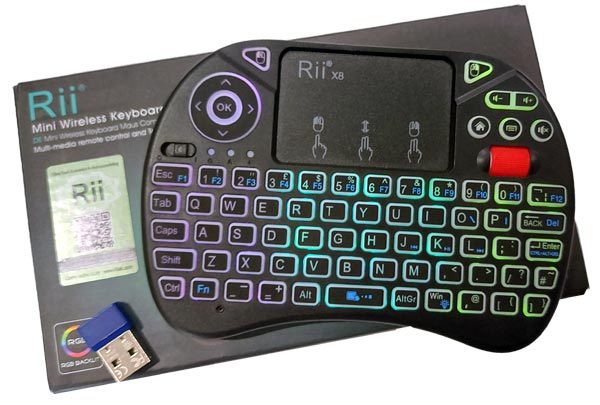
If you're reasonably competent with website design, you can create a personalised landing page with links to all your favourite media sites. By running this page locally on your PC, you can use Firefox Kiosk Mode to transform your computer into a full-screen, dedicated Smart TV / Media Center that removes the address bar and other browser menus.
To launch your landing page (or any website) in firefox kiosk mode, use the appropriate terminal command for your operating system. As I use linux, The path_to_local_webpage on my computer can be found on the following path /home/username/bin/landing_page.html
Linux
firefox --kiosk (path_to_local_webpage)
Mac
/Applications/Firefox.app/Contents/MacOS/firefox --kiosk (path_to_local_webpage)
Windows (Command Prompt or PowerShell)
"C:Program FilesMozilla Firefoxfirefox.exe" --kiosk (path_to_local_webpage)
Please Note: A standard website link in your landing page, cannot directly launch a new URL in Firefox Kiosk Mode. To navigate to an external site while maintaining the kiosk function:
Linux Solution: Point your link to a bash script instead of a direct URL. Inside this script, you place the command to launch a new instance of Firefox in kiosk mode with the target URL. (For detailed instructions on using HTML links to execute local apps/scripts, refer to the provided
Ask Ubuntu link.
Windows/Mac Solution: Similar scripting solutions (like batch files or Automator scripts) would be needed to handle the launching of a new, separate Kiosk window.
Example
landing_page.html link and bash script
youtube.sh that opens YouTube in firefox kiosk mode
HTML Code (landing_page.html)
<a href="app:///home/username/bin/youtube.sh">You Tube</a>
Bash Script (youtube.sh)
#!/bin/bash
# YouTube website
firefox --kiosk https://www.youtube.com/
Exiting and Returning to the Landing Page
Since Kiosk Mode disables the address bar and window controls, you can't use a touchpad or mouse to close the page.
When you launch a new website (via the method above), it will open in a separate Kiosk window. You can close this window and return to your landing page by using the universal close shortcut:
To close the current kiosk window
Press
CTRL +
w (on Windows/Linux),
Command ⌘ +
w (on Mac).
This will close the current site, leaving your original landing page running in the background, ready for the next selection.
User Friendly
On Linux, the functionality of the Home button on a
mini keyboard/touchpad can be remapped to close the active Firefox window.
This is accomplished by establishing a new keyboard shortcut that maps the Home button to a Bash script. The bash script, leveraging the xdotool package, then executes the necessary command to terminate the Firefox process. Different operating systems (Windows and Mac) will require alternative mapping methods.
Another option is to assign a
mini keyboard/touchpad button or key to a Bash script leveraging the xdotool package for browser history navigation (back).
Other Improvements & Ideas
Firefox Extensions
You can further improve your viewing experience by installing the following firefox extensions
-
Hide Scrollbars
-
Universal Video Hotkeys
Not all websites automatically load videos in full screen. This Firefox extensions maps the f key on your keyboard to show full screen video.
-
YouTube auto fullscreen
This extension automatically loads videos in full screen mode on YouTube.
Other Ideas
Using Javascript to map numbers on your keypad to open various webpages in kiosk mode for live TV. For example pressing 1 on my keypad opens BBC1 live TV stream and makes the system feel a bit more user friendly.
As it's your webpage, you can add whatever background or video background you like to your TV Homepage
The improvements you could make to your own system are endless, and I hope this tutorial has given other users some ideas.